
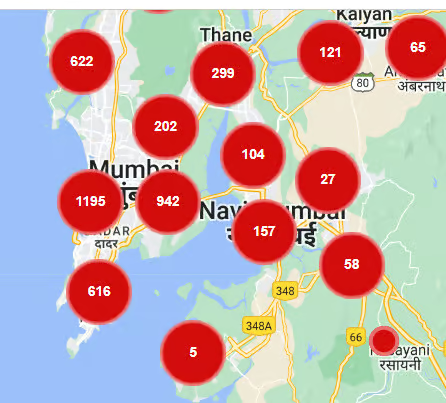
In India, auto-rickshaws are the backbone of intermediate public transport (IPT), providing essential last-mile connectivity. However, while buses and metros have received significant safety interventions, the unique vulnerabilities within auto-rickshaws, particularly safety concerns still remain largely underexplored in formal transport discourse.
This study draws on data from Safecity, a flagship platform by the Red Dot Foundation. Safecity is a crowdsourcing tool that allows individuals to anonymously report incidents of sexual harassment and abuse in public spaces. By aggregating these individual data points into hotspots, Safecity transforms personal lived experiences into actionable patterns for urban planning and policy advocacy. By filtering these lived experiences through an environmental lens, several critical patterns emerge regarding the ‘security gap’ inherent in auto-rickshaw travel. Following are a few key insights drawn from this study:
- The semi-open design of auto-rickshaws, intended for visibility and ventilation, creates a “security gap.” The lack of a physical barrier and the unregulated nature of shared rides allow for “unregulated entry and exit,” making passengers vulnerable to harassment without easy redressal.
- Unlike organized transit, auto-rickshaws lack a central authority figure or a guardian (like a bus conductor or station guard). This absence of a structured accountability system places the entire burden of safety on the passenger.
- Environmental criminology reveals that the physical interaction between the vehicle’s small, confined space and its surroundings dictates safety. Most incidents occur in the absence of active guardianship, yet the study highlights that “bystanders” such as nearby shopkeepers, fellow commuters, and even sanitation workers are the most underutilized safety resource.
The Red Dot Foundation’s study advocates for a transition from passive environments to proactive zones of community safety. Key recommendations include:
- Bystander Intervention: Moving toward a culture of “Active Guardianship,” where bystanders from the shopkeeper on the corner to the passenger in the next seat are empowered and aware to disrupt harassment before it escalates.
- Policy & Visibility: Strengthening existing interventions like “Pink Autos” (women-driven) and visible driver identification, while integrating SGBV reporting into urban mobility planning.
- Shared Responsibility: Moving beyond technical design to foster a culture where safety is a collective, civic responsibility rather than an individual burden.
- Urban Planning: Recognizing that paratransit requires the same rigorous safety standards and accountability structures as formal rail or bus systems.
The data from Safecity confirms that SGBV in auto-rickshaws is not a series of isolated incidents, but a predictable outcome of specific environmental and social gaps. However, by identifying these “blind spots” in paratransit, we move closer to a transport ecosystem that refuses to trade safety for convenience. Ultimately, making auto-rickshaw travel safer is about reclaiming the right to the city. When we design for the most vulnerable passenger, we create a more efficient, inclusive, and dignified transport network for everyone.
Interested in implementing data-driven safety interventions in your city? Connect with us at to learn more about Safecity’s methodology and our work in transforming urban mobility.