
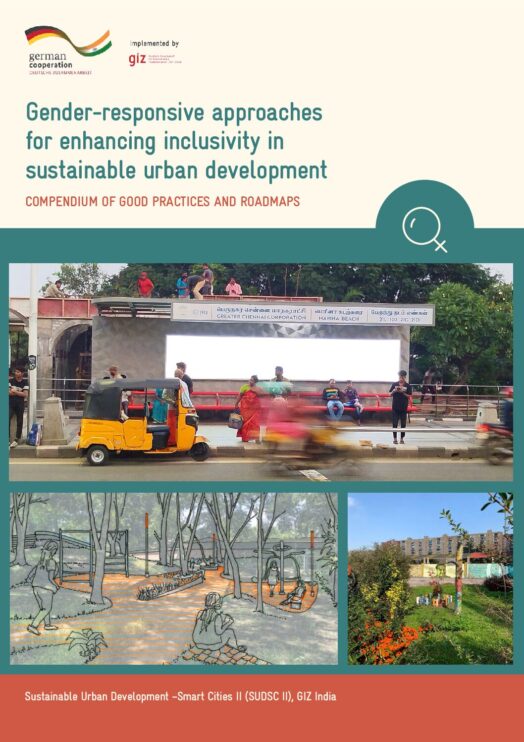
“Gender-Responsive Approaches for Enhancing Inclusivity in Sustainable Urban Development” is a compendium of good practices and roadmaps developed by GIZ India and Col·lectiu Punt 6, with SriPallavi Nadimpalli as gender planning consultant for the Indian case studies. It is an output of the Sustainable Urban Development – Smart Cities II (SUDSC II) project, implemented by GIZ on behalf of the German Federal Ministry for Economic Cooperation and Development (BMZ), supporting India’s Ministry of Housing and Urban Affairs and the partner states of Assam, Karnataka, Kerala, Odisha, Tamil Nadu and Telangana.
The compendium brings together 30 case studies, 15 global and 15 Indian, on embedding an intersectional gender and feminist perspective across urban planning, governance and service delivery. Rather than presenting isolated success stories, each case study is treated as an implementation model: it sets out the challenge addressed, the institutional processes and partnerships behind it, the lessons learned, and how the approach could be adapted elsewhere.
Several case studies speak directly to feminist transport work. In Mexico City, the 2019 Strategic Plan for Gender and Mobility set out three lines of action for the Secretariat of Mobility and the Integrated Transport System: reducing sexual violence and assault in transit, strengthening gender parity and institutional culture in the transport sector, and addressing women’s specific travel needs, including care-related travel. In Mirzapur, Uttar Pradesh, a mobility barrier identified through community listening sessions became the starting point for a women-led e-rickshaw network that today counts more than 180 vehicles across five districts, giving over 100,000 women and girls access to safe mobility, supported by peer groups (Aarya Groups) and a multistakeholder platform (Aarya Manch) connecting drivers with transport authorities and traffic police. In Guwahati, a tactical urbanism pilot at the Ganeshguri junction led to the permanent redesign of a high-risk intersection, reclaiming public space for pedestrians and reducing crossing distances and waiting times, prioritising women, children, elderly and differently abled residents.
Beyond the case studies, the compendium includes a conceptual section on gender-transformative urban development and the unequal impacts of climate change in cities, and closes with recommendations across five areas: capacity building on feminist urban planning, implementation of gender policies and regulations, gender-responsive urban assessments, participatory transformation, and gender-responsive monitoring and evaluation.
The compendium is intended as a practical resource for local governments, planners and communities working toward safer, more accessible and inclusive cities.