When Women Ride, Cities Are Free
By Tannaz Tabrizi, Mobility Engineer and Urban Planner, Milan
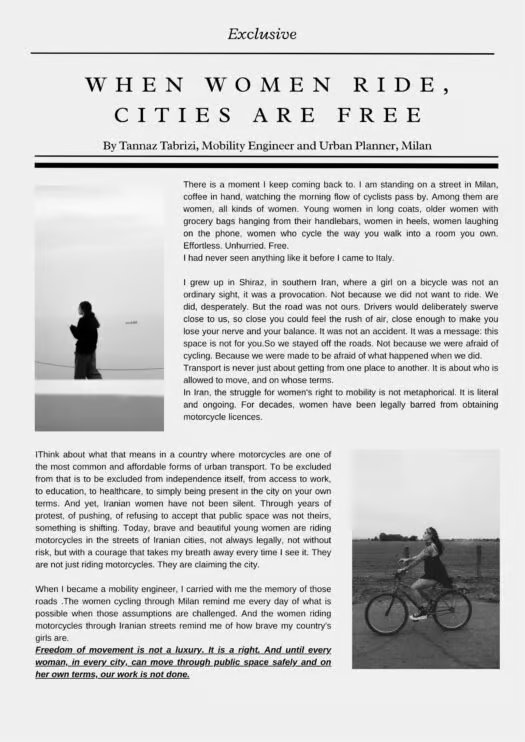
There is a moment I keep coming back to. I am standing on a street in Milan, coffee in hand, watching the morning flow of cyclists pass by. Among them are women, all kinds of women. Young women in long coats, older women with grocery bags hanging from their handlebars, women in heels, women laughing on the phone, women who cycle the way you walk into a room you own. Effortless. Unhurried. Free.
I had never seen anything like it before I came to Italy.
I grew up in Shiraz, in southern Iran, where a girl on a bicycle was not an ordinary sight, it was a provocation. Not because we did not want to ride. We did, desperately. But the road was not ours. Drivers would deliberately swerve close to us, so close you could feel the rush of air, close enough to make you lose your nerve and your balance. It was not an accident. It was a message: this space is not for you.
So we stayed off the roads. Not because we were afraid of cycling. Because we were made to be afraid of what happened when we did.
Transport is never just about getting from one place to another. It is about who is allowed to move, and on whose terms.
In Iran, the struggle for women’s right to mobility is not metaphorical. It is literal and ongoing. For decades, women have been legally barred from obtaining motorcycle licences. Think about what that means in a country where motorcycles are one of the most common and affordable forms of urban transport. To be excluded from that is to be excluded from independence itself, from access to work, to education, to healthcare, to simply being present in the city on your own terms.
And yet, Iranian women have not been silent. Through years of protest, of pushing, of refusing to accept that public space was not theirs, something is shifting. Today, brave and beautiful young women are riding motorcycles in the streets of Iranian cities, not always legally, not without risk, but with a courage that takes my breath away every time I see it. They are not just riding motorcycles. They are claiming the city.
My own research, conducted in collaboration with Italy’s national railway manager RFI, found that among all accessibility indicators studied across more than 1,000 Italian railway stations, micromobility connectivity had the strongest positive effect on surrounding real estate values. In other words, the places best connected by bikes, e-scooters and shared micromobility were also the places that became more liveable and desirable. But behind those numbers is something simpler: micromobility works because it gives people, and especially women, a way to move through cities that is affordable, flexible, and human-scaled.
Transport equity is not a niche issue. It sits at the intersection of gender, class, age, disability, and geography. A woman who cannot safely ride a bicycle to the train station, or who cannot afford a car, or who feels unsafe waiting alone at a bus stop at night, is a woman whose access to the city is constrained in ways that compound across a lifetime.
When I became a mobility engineer, I carried with me the memory of those roads in Shiraz, and the awareness that infrastructure is never neutral. Every design decision, where a lane goes, how wide it is, how well it is lit, whether it connects to public transport, encodes a set of assumptions about who matters and who moves.
The women cycling through Milan remind me every day of what is possible when those assumptions are challenged. And the women riding motorcycles through Iranian streets remind me of how brave my country’s girls are.
Freedom of movement is not a luxury. It is a right. And until every woman, in every city, can move through public space safely and on her own terms, our work is not done.
Tannaz Tabrizi is a mobility engineer and urban planner based in Milan, Italy. She is passionate about inclusive and sustainable urban mobility.